
The Achilles Heel of the European Economy

Share this article
The European Union presents itself to the world as one of the largest and most sophisticated economic blocs in history. Its regulatory frameworks, its institutions, its currency, and its collective market power represent decades of deliberate construction. And yet beneath this architecture sits a structural vulnerability that no treaty, directive, or summit has yet resolved: Europe does not produce the energy its economy requires to function.
This is not a policy failure in the conventional sense. It is a geological and political condition with profound economic consequences, one that shapes the bloc’s purchasing power, constrains its foreign policy options, and increasingly determines who holds leverage in the relationships that matter most to the continent’s future.
The Nature of the European Dependency
The European economy runs on imported energy. Oil and petroleum products represent the dominant category of what the continent purchases from the rest of the world each year, and the annual expenditure associated with this dependency is among the largest recurring outflows of European capital in existence. It does not generate a return. It does not build an asset. It sustains a standard of living whose foundation is controlled entirely by parties outside the bloc.
This dependency carries consequences that extend well beyond the energy bill itself. When global commodity markets move, Europe’s economic condition moves with them, not as a participant with leverage but as a buyer without alternatives. The elevated energy costs that have characterized the European economic environment in recent years are not merely a function of external events. They are a function of structural exposure that makes every external event more consequential than it would be for an economy with domestic supply.
The household bears a disproportionate share of this burden. Energy costs embedded in transportation, heating, food production, and manufactured goods transmit commodity price volatility directly into the living standards of European consumers in ways that fiscal policy cannot easily offset and monetary policy cannot address at all. The continent’s competitiveness, particularly in energy-intensive industrial sectors, carries the same structural handicap.
The Norwegian Exception and What It Reveals
The most significant oil and natural gas producer in Western Europe is not a member of the European Union. This is not an accident.
Norway has twice declined EU membership in national referendums, and its relationship with the bloc has been one of continuous negotiation over the terms of engagement rather than integration. The energy dimension of this arrangement is central. Norway’s hydrocarbon industry is the foundation of its sovereign wealth and its economic identity. The state-managed oil enterprise that anchors this industry operates under a model that is fundamentally incompatible with the EU’s competition framework, state aid rules, and the trajectory of its environmental legislation.
The tension between Norway and the EU over energy directives has grown more acute rather than less. As recently as early 2026, the Norwegian government collapsed over a dispute between coalition partners on the adoption of EU energy legislation, with one party concluding that compliance with Brussels’ evolving framework would erode Norwegian autonomy over its own electricity pricing and energy regulation. The country that supplies a significant portion of the EU’s natural gas needs exists outside the EU precisely because full membership would require it to subordinate its energy industry to the regulatory environment of its largest customer.
This arrangement is as revealing as it is ironic. The EU’s environmental and regulatory framework, among the most ambitious in the world, has contributed to the conditions that prevent the bloc from accessing the only significant hydrocarbon production in its immediate geographic neighborhood through a membership relationship. Norway exports energy to Europe while carefully maintaining the sovereign distance that allows it to operate on its own terms.
The Capital Markets Dimension
Europe’s structural inability to develop domestic energy resources is not solely a function of geology or environmental law. It is also a function of the financial architecture within which European investment operates.
The fragmentation of European capital markets, the absence of a unified legal and regulatory framework for large-scale energy investment, and the risk management frameworks applied within European institutional capital have collectively produced an environment in which the development of domestic hydrocarbon resources is systematically underfinanced relative to what the geologic opportunity might support. European capital, where it has engaged in energy exploration and extraction, has done so within constraints that do not apply to the institutions that have come to dominate this activity.
The practical consequence is visible in the map of who is actually exploring and extracting the resources that exist within European waters and on the European continental shelf. The Adriatic, the Ionian, and the Eastern Mediterranean carry documented hydrocarbon potential. The exploration programs active in these waters are led predominantly by institutions whose capital base, risk tolerance, and operational capability reflect the American rather than the European investment environment. Projects in Eastern Mediterranean waters are advancing under the direction of U.S based energy operators.
The absence of investment frameworks within the European capital markets architecture is precisely what creates the conditions for this outcome. The instruments through which American capital is structured to participate in domestic energy exploration carry tax treatment and return profiles that European institutional and private capital cannot replicate. The result is not a failure of European ambition. It is a structural vacuum that capital from outside the bloc is filling, on its own terms, with its own strategic objectives.

The Infrastructure That Is Redrawing the Map
The most consequential energy infrastructure development in Europe today is not taking place in the North Sea or the Central European pipeline network. It is taking place in the southeastern corner of the continent, in a configuration that is quietly shifting the geography of European energy supply and, with it, the geography of economic and political influence.
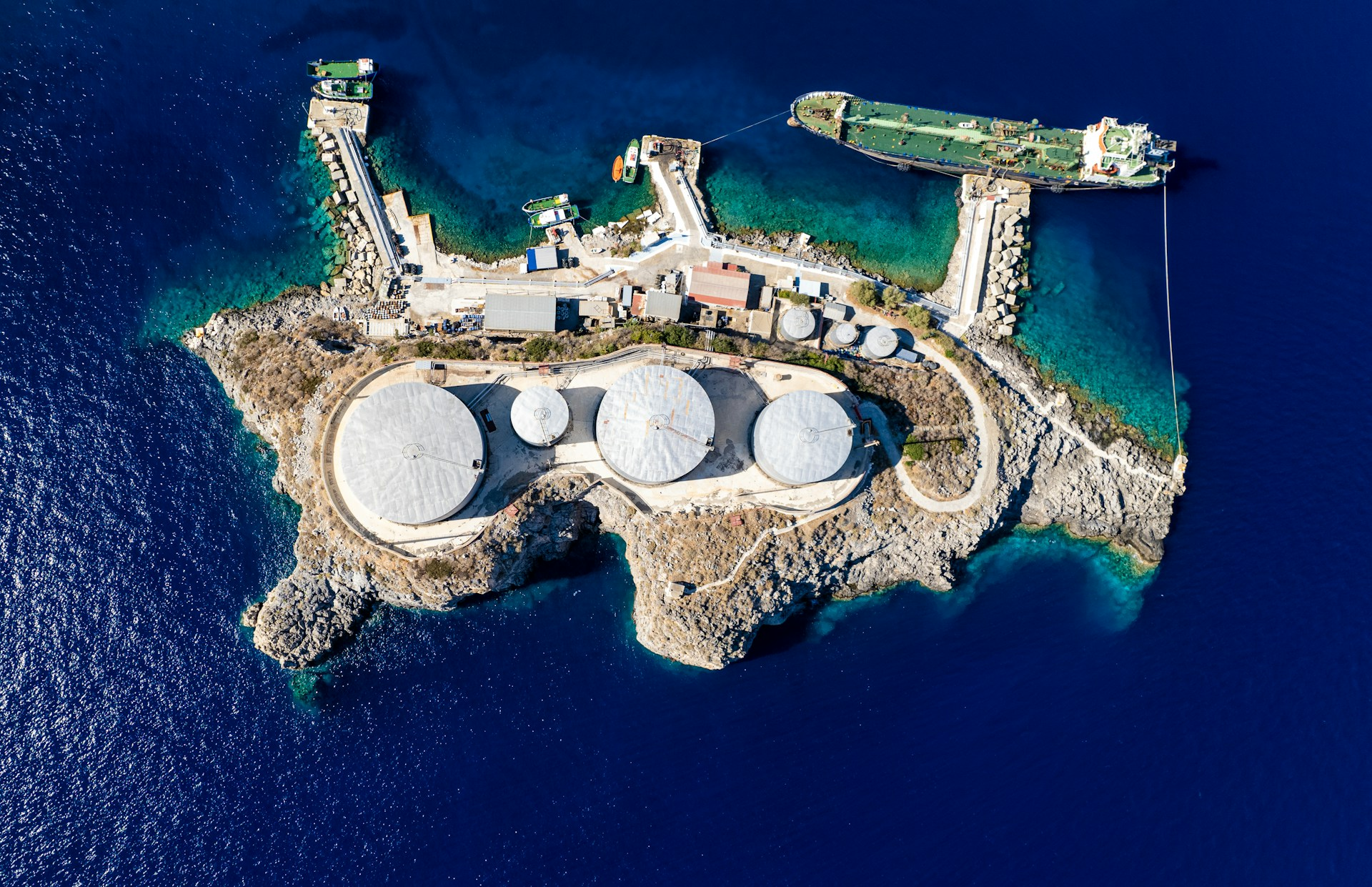
The LNG import terminal that became operational in the northeastern Greek port of Alexandroupolis feeds a gas corridor that runs northward through Bulgaria and into Central and Eastern Europe. The volumes moving through this corridor originate primarily from American liquefied natural gas and Azerbaijani pipeline supply. The terminal connects directly to the Trans-Adriatic Pipeline, which carries gas westward across northern Greece and through Albania into Italy and the broader Western European gas network.
This infrastructure does not merely change where Europe’s gas comes from. It changes who controls the chokepoints through which that gas travels, and it changes the economic and political weight of the countries that sit along those routes.
Greece and Albania have, in the period during which this infrastructure has been developed and commissioned, positioned themselves as indispensable nodes in Europe’s energy security architecture. This position carries consequences that extend well beyond the pipeline. Countries that control supply routes to an energy-dependent continent carry negotiating leverage that pure economic metrics do not capture. The influence that accrues to geography, when that geography sits at the intersection of where energy comes from and where energy needs to go, translates directly into the ability to shape policy conversations at the continental level.
The Eastern Mediterranean and the Emerging Supply Architecture
The Eastern Mediterranean has become one of the most consequential energy geographies on the planet. Significant gas discoveries in the waters of Cyprus and in the broader region have established a resource base whose development trajectory will shape European energy markets for decades.
The alignment of interests among the states positioned to develop and export these resources has crystallized into a formal framework. Greece, Cyprus, and Israel, with direct United States engagement, have established what has become known as the 3+1 framework: a structured alignment around energy security, supply infrastructure, and regional stability whose December 2025 summit in Jerusalem reaffirmed commitments to flagship connectivity projects and the broader supply architecture they represent.
The economic corridor that the participants in this alignment are working to operationalize extends further than the Eastern Mediterranean itself. The India, United Arab Emirates, Israel, Cyprus, Greece routing that underpins the IMEC economic corridor represents an ambition to create an integrated supply and trade route that bypasses the conventional geographies of global commerce and connects the economic dynamism of South Asia and the Gulf directly to European markets through a southeastern European gateway.
This is a commodities story before it is a political one. The question of where energy flows, through whose territory, under whose commercial terms, and with what degree of supply security is ultimately a question about prices, about risk premiums, and about which economic actors control the variables that determine the cost of energy for the world’s largest importing bloc.
The Consequence for the Continental Power Structure
What is emerging from the combination of new supply infrastructure, Eastern Mediterranean resource development, and the reorientation of supply routes is a shift in the effective center of gravity of European economic influence. The authority that Brussels exercises over the bloc is built in part on its role as the regulatory and political center through which European interests are expressed externally. That authority is being diluted, not by political challenge, but by the mundane mechanics of commodity supply.
Countries that were peripheral in the previous European energy architecture are becoming central in the new one. The economic weight that follows from controlling supply routes to an import-dependent continent does not require a vote in the European Parliament or a position in the European Commission. It is structural, geographic, and, once the infrastructure is built, durable. Athens is not replacing Brussels. But it is acquiring a form of leverage that Brussels cannot easily replicate and does not fully control.
This dynamic is not unique to energy. The history of commodity markets is substantially a history of how the control of supply creates economic and political power that outlasts the immediate commercial transaction. Europe, as a continent that has spent decades attempting to pool sovereign interests into collective institutions, is discovering that the fundamental asymmetry of its energy position places limits on what collective institutions can achieve when the supply of the commodity those institutions depend upon is controlled by parties who are not members of those institutions.
At Guzhuna, we examine not as observers of geopolitics but as advisors to clients whose portfolios, planning horizons, and risk exposures are affected by the structural conditions it describes. The pricing of European energy, the investment flows it attracts, the infrastructure it is building, and the geographic shifts it is producing all carry implications that belong in a serious conversation about how capital is positioned in a world where the map of energy supply is being redrawn in real time.
Let's start a conversation today.
About the Author
Jori Guzhuna
Jori Guzhuna is the Founder and Chief Executive Officer of Guzhuna Financial Group, where he advises entrepreneurs, executives, and affluent families on sophisticated wealth, risk, and estate planning strategies. His practice focuses on integrating investment management, tax-efficient planning, financial architecture, executive compensation, and asset protection into cohesive long-term plan.
Known for his institutional approach and strategic perspective, Jori specializes in helping clients navigate complex financial environments involving business succession, multigenerational wealth transfer, cross-border planning, and liability management. His work often centers around protecting wealth while creating structures designed to support long-term continuity for families and closely held businesses.
As a fiduciary advisor, Jori brings a disciplined and risk-conscious philosophy to financial planning. He works closely with clients to simplify complex financial decisions and develop customized strategies aligned with their personal, business, and legacy objectives.
In addition to wealth planning, Jori has extensive experience in commercial risk management, employee benefits, executive compensation, and insurance planning. This broad perspective allows him to deliver comprehensive solutions that address both wealth creation and wealth preservation.
Jori earned his bachelor’s degree from New York University.