...

Does My State Require Me to Offer Employees a Retirement Plan?

retirement plan

Across the United States, a growing number of states have enacted legislation requiring private sector employers to provide their employees with access to a retirement savings program. The mandate is clear. What is far less clear to most business owners is what they are actually agreeing to when they choose the path of least resistance and enroll in whatever their state has built for them.

The state program is designed to solve a public problem. It is not designed to serve the specific interests of any particular employer, their workforce, or their ambitions as a business. Understanding that distinction is the difference between checking a compliance box and building something that works.

A Wave That Is Not Receding

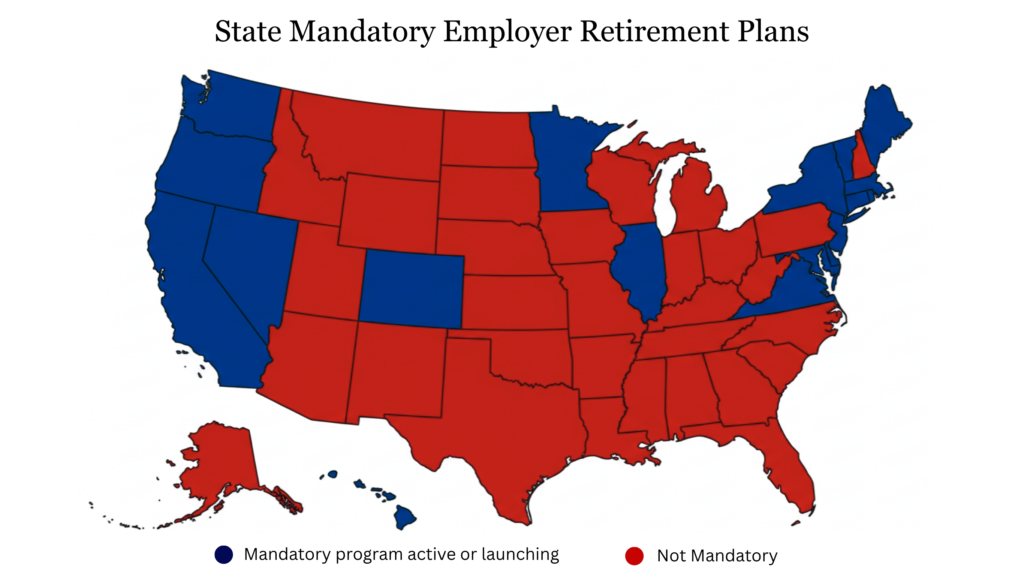
The number of states with active mandatory programs has grown significantly over the past several years and continues to expand. States including California, Colorado, Connecticut, Delaware, Hawaii, Illinois, Maine, Maryland, Minnesota, Nevada, New Jersey, New York, Oregon, Rhode Island, Vermont, Virginia and Washington have either launched or are actively launching programs with defined deadlines and escalating penalties for non-compliance.

The threshold for coverage varies by state. Some require participation from employers with a single employee. Others set the threshold at five, ten, or twenty-five. In every case, the mandate contains an important provision that most employers are not sufficiently aware of: an employer who already sponsors a qualifying retirement plan is exempt. The obligation only applies to those who offer nothing.

That exemption is not a technicality. It is an invitation.

Which States Require Retirement plans
Created by Guzhuna Financial Group Ltd.

What the State Builds and Why It Falls Short

State programs are structured to achieve a defined social objective: to ensure that workers who would otherwise have no access to retirement savings have at least some mechanism through which to accumulate them. That objective is legitimate and the programs serve it adequately.

They do not, however, serve the employer.

State programs typically offer employees a narrow range of investment choices selected and managed by a financial institution designated by the state. Employees are auto-enrolled at a fixed default contribution and the program operates on standardized terms that no individual employer can modify. There is no employer contribution. There is no matching. There is no flexibility in plan design, investment menu, eligibility criteria, or distribution rules.

For an employee trying to build retirement savings from a modest income, this is meaningfully better than nothing. For an employer trying to compete for skilled professionals, attract experienced executives, retain productive team members, and create a culture of genuine commitment, it is not a benefit. It is a utility.

The gap between what a state program offers and what a well-designed employer-sponsored plan can deliver is substantial. The savings capacity available through a qualifying private plan is considerably greater than what a state auto-enrollment program permits. Investment options are broader. Plan design can be customized around the workforce, the business model, and the goals of both the employer and their key people. Employer contributions, where structured thoughtfully, serve simultaneously as a retention mechanism, a compensation strategy, and a tax-efficient deployment of business capital.

None of these dimensions exist within a state program.

The Cost of Compliance Without Strategy

There is a quiet assumption among many employers navigating these mandates for the first time. The assumption is that the state program is the low-cost option and that a private plan is expensive. This assumption is, in most cases, incorrect when the full picture is examined.

State programs carry no direct employer cost at the point of enrollment. That much is accurate. What is less visible is the ongoing cost of offering employees a retirement benefit that serves them poorly. Lower savings capacity. Limited investment options. No employer contribution. These are not neutral features. They are competitive disadvantages in a labor market where access to a meaningful retirement benefit has become one of the primary factors that influences whether a candidate accepts an offer and whether an employee remains.

For a business competing for talent against employers who have invested in their people’s financial futures, the state program is not a cost-saving measure. It is a structural impediment dressed as a compliance solution.

What you need to know before Selling Your Business

The Tax Implications of Selling Your Business: What to Plan Before You Sign The decision to sell a...

What a Thoughtfully Designed Plan Actually Does

The employers who approach this obligation strategically arrive at a different question than the ones simply trying to comply. They do not ask what the state requires. They ask what their business needs and what their people deserve.

A well-constructed employer-sponsored retirement plan does several things simultaneously. It satisfies the compliance obligation in every applicable state. It provides employees with meaningfully superior savings capacity and investment access. It creates an architecture within which key executives can be rewarded in ways that align their long-term interests with the interests of the business. And it positions the employer as one who takes the financial futures of their people seriously, which is increasingly the standard that high-caliber professionals use to distinguish between opportunities.

The plan that serves all of these purposes is not the same plan for every business. It depends on the composition of the workforce, the tax position of the business and its owners, the competitive landscape in which the employer operates, and the specific retention and growth objectives the leadership team is pursuing. There is no off-the-shelf solution that addresses all of it. The off-the-shelf solution is precisely what the state provides.

The Executive Dimension

For businesses with key personnel whose compensation and long-term commitment represent significant drivers of enterprise value, the retirement planning conversation extends well beyond what any state program touches.

The mechanisms through which an employer can align the financial interests of senior people with the trajectory of the business over time are among the most powerful tools available in compensation design. Used correctly, they serve the executive, the business owner, and the enterprise simultaneously. They address retention with considerably more precision than a salary adjustment. They create incentives that are tied to outcomes rather than tenure. And they accomplish this within a planning framework that, for the business, carries meaningful tax implications of its own.

This dimension of the conversation is invisible from within a state-mandated program. It only becomes accessible once an employer moves from the compliance mindset to the strategic one.

At Guzhuna, we work with business owners and their leadership teams to design retirement plans that begin with compliance and end with something considerably more valuable. The state mandate is the floor. What we build together is the structure above it, one that rewards the people who matter most, positions the business to attract the talent it needs, and integrates the retirement plan into the broader financial architecture of the enterprise in a way that serves the owner’s goals for years and often decades ahead.

Let's start a conversation today.

About the Author

Jori Guzhuna

Jori Guzhuna is the Founder and Chief Executive Officer of Guzhuna Financial Group, where he advises entrepreneurs, executives, and affluent families on sophisticated wealth, risk, and estate planning strategies. His practice focuses on integrating investment management, tax-efficient planning, financial architecture, executive compensation, and asset protection into cohesive long-term plan.

Known for his institutional approach and strategic perspective, Jori specializes in helping clients navigate complex financial environments involving business succession, multigenerational wealth transfer, cross-border planning, and liability management. His work often centers around protecting wealth while creating structures designed to support long-term continuity for families and closely held businesses.

As a fiduciary advisor, Jori brings a disciplined and risk-conscious philosophy to financial planning. He works closely with clients to simplify complex financial decisions and develop customized strategies aligned with their personal, business, and legacy objectives.

In addition to wealth planning, Jori has extensive experience in commercial risk management, employee benefits, executive compensation, and insurance planning. This broad perspective allows him to deliver comprehensive solutions that address both wealth creation and wealth preservation.

Jori earned his bachelor’s degree from New York University.


Credentials:

Finra: SIE Series 7 Series 63 Series 65 Series 24
Insurance: Life • Accident • Health • Property • Casualty
Seraphinite AcceleratorOptimized by Seraphinite Accelerator
Turns on site high speed to be attractive for people and search engines.